

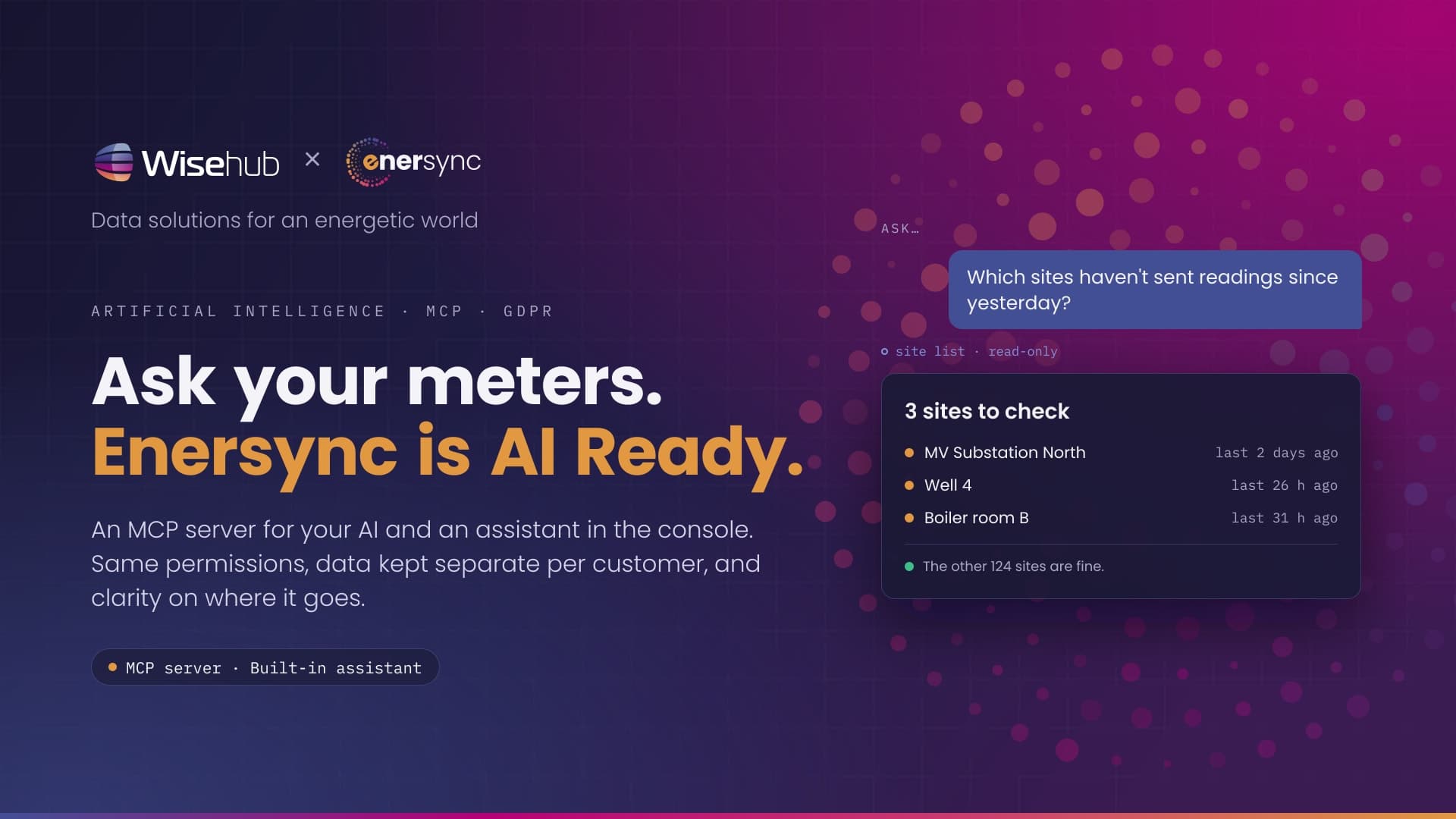
A remote metering platform collects millions of readings, load curves, alarms and events every day. The problem is no longer having the data: it is getting to it quickly. How much did the plant use in September? Which sites have not transmitted since yesterday? Today, answering means opening three screens and a spreadsheet.
From today, you just ask. Enersync is AI Ready.
What changes
There are two new features.
- An assistant in the console. At the top there is the "Ask…" field: type your question as you would ask a colleague, and the assistant answers with your data.
- Your data in your AI. If your company already uses Claude, ChatGPT, Gemini or Copilot, you can connect them to Enersync through an MCP server, the open standard that AI assistants use to work with external tools. You connect with your Enersync sign-in in a few minutes, and you are not tied to any AI vendor, now or in the future.
A few example questions:
- "Which sites haven't sent readings since yesterday?"
- "How much did the Via Roma plant use in September, week by week?"
- "Compare August and September for my three largest sites."
The rules, in short
The AI sees only what the user sees: never another customer's data. It reads and does not act: actions in the field stay with the operators. Every request is recorded in the audit log, like any other integration.
We are precise about privacy. The console assistant uses a model that runs in the United States: it is the only feature of the platform that takes consumption data outside the European Union, and only for those who choose to switch it on. Your data is not used to train the model, and the text of conversations is never kept in our logs. Everything else (readings, curves, registries, reports and archives) stays on our servers in the European Union. The details are in the privacy notice.
A note from Europeans
Let us be frank. To offer the best model available today, we had to look across the ocean. It is not an ideological choice: the most capable models are almost all built outside Europe. According to Stanford's AI Index, in 2024 the United States produced 40 notable models, China 15, Europe 3.
Europe chose to arrive with the rules before the technology. The AI Act entered into force in 2024 and, two years later, part of its obligations has already been postponed to 2027 and 2028 because the technical standards needed to apply it were not ready. Meanwhile, models are being built, funded and sold elsewhere.
On this, today, our hands are tied. But technology does not wait, and standing still until European governments make a move would mean leaving our customers behind. Rules matter: the GDPR has made the whole sector more serious about handling data. But a rule without an industry to grow leaves us as spectators. The day the best model is European, we will be ready to use it: with an open standard like MCP, changing models does not mean rewriting the platform.
Where to start
Console users will find the "Ask…" field in the top bar. To connect your own AI, or if you have a use case in mind, from internal support to consumption analysis for your customers, get in touch: we will help you set it up.